

Notable film reviews from 2023, written by UNG alumni, students, and faculty.
Train Dreams (Clint Bentley)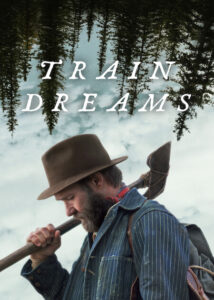
In the opening moments of Train Dreams, a camera fixed to a tree looks skyward as the trunk begins to sway. The image shifts as the sky meets the horizon, and the tree crashes to the ground. A simple shot, yet a daring feat of cinematography that asks audiences to consider the danger, beauty, and simplicity of existence. This is a film about perspective, about the uneasy coexistence between our ambition and the natural world that dwarfs us.
Set in the early 20th-century American Northwest, the film follows Robert Grainier (Joel Edgerton), a laborer whose life unfolds in quiet collision with the landscape around him. His relationship with his wife (Felicity Jones) offers moments of tenderness and romantic optimism, but Bentley resists the pull of conventional narrative drama. Instead, the film observes, patiently and almost reverently, as time passes, structures are built and lost, death peppers the plot, and meaning proves elusive.
What makes Train Dreams notable is the rigor of its form. Cinematographer Adolfo Veloso reportedly shot the film almost entirely with natural light, lending each frame an organic quality. Production designer Alexandra Schaller extends that philosophy into the physical world. The cabin Grainier builds is not a set but a structure erected on location, exposed to the elements. These choices create a tactile environment where production design and landscape become indistinguishable.
And yet, this is not an exercise in austerity. A guiding narration and measured score remind us that this is a constructed memory. By the film’s end, Bentley shifts our vantage point to the sky, lifting us high above the terrain Grainier has spent a lifetime navigating and reframing the story as something closer to acceptance than resolution. Dreams persist, becoming memories shaped by time, by loss, and by the quiet understanding that both human life and the natural world are defined by impermanence.
And what a beautiful thing impermanence can be.
James Mackenzie
Eddington (Ari Aster)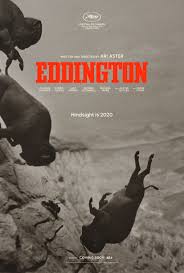
Ambitious as it is scathing, Ari Aster’s Eddington is a masterful work of genre subversion. It essentially functions as a satire of 2020s America and cultural divisions within but is cleverly filtered through the western genre lens, updating its signature hallmarks. Eddington is a quasi-rural New Mexico town in the throes of the early COVID-19 pandemic, while scheming Mayor Ted Garcia (Pedro Pascal) clashes with the pathetic, nervous Sheriff Joe Cross (Joaquin Phoenix) on how to handle the situation. Ted is quietly fighting for a huge AI data center to be built just outside their town and struggles to maintain a relationship with his son, who he has no qualms about using for re-election ads. Joe is burying his head in the sand, desperately trying to keep his marriage to Louise (Emma Stone) from disintegrating, while she and her mother (Deirdre O’Connell) wallow in online conspiracy theories. Throw in a smooth-talking charlatan (Austin Butler) determined to “save” Louise, teenagers protesting police violence, plus his own impulsive, shoddy mayoral campaign, and Joe’s got his hands full.
There’s an uncanny verisimilitude to the film’s atmosphere, but this is just one layer of the onion. Aster recognizes the core appeal of the Western film, on both an aesthetic and structural level. In a more obvious scene, he pits Joe against Ted on the deserted main road. A lone piece of paper drags across the street like a tumbleweed. Neither of them have guns, but Joe is recording the interaction with his phone, and the physical distance between them is not one of anticipatory violence, but six feet to prevent infection.
Phones operate as weapons in Aster’s western, manipulative instruments as well as recorders. There are several memorable shots wherein a phone is recording a character in the foreground while they remain out of focus in the background, trapping them within the digital screen’s confines. This highlights the identity crisis rendered by an impossibly overwhelming connection to everything and nothing. The ultimate selling point is not the dynamism of the “Firework” scene, the comparisons to Nashville or Targets, the hilarious satire, or even the explosive Travis-Bickle-like gunfight, but in seeing all of these disparate components come together to demonstrate a mastery of the cinematic medium and the defining epic of an era.
Chayce Ward
Die My Love (Lynne Ramsey)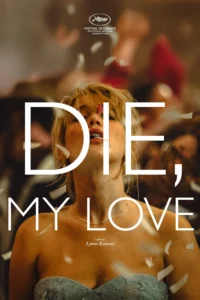
“A real mom would have baked a cake.”
Adapted from Ariana Harwicz’s novel of the same name, Die My Love traps its audience from the opening image. In a static frame within a frame – within a frame – we eventually meet writer Grace, portrayed by an electrified Jennifer Lawrence, alongside her soon to be baby daddy Jackson, a gruff, sometimes child-like Robert Pattinson. They’ve seemed to wander, quite literally, into an abandoned home – and director Lynn Ramsey’s intentional frame. The decrepit home, passed down by a relative, sits far off the beaten path in the American West, and is probably the only home they could ever afford. A drunken night of carnal desire evaporates into parenthood.
Whether prowling through the grass with a knife or dancing without inhibition, Lawrence blends absurd humor with spontaneous agitation and paranoid rage. Motherhood has not come natural for Grace. Feeling confined, she now produces more milk on a page than words. Her enraptured performance, however, is often tender as well. For example, one of the most poignant scenes plays out early on when pregnant Grace helps a struggling Nick Nolte tie his shoe. Scenes with legendary Sissy Spacek haunt as we witness two women at completely different stages of life struggle with the female experience: one actively fighting the turnover of freedom to caregiving and another completely lost after losing the husband she took care of for decades.
As the narrative unravels, so does Grace. Ramsey doesn’t offer much backstory or explanation, which feels discombobulating, especially when a stranger shows up on a motorcycle. This recurrence is soaked in symbolism, as is the wildfire and horse. Threads intertwine to create a tone that suffocates. Ramsey’s camera often feels cloistered, suggesting that what lies just beyond the frame is as important, if not more so than what we see. A master of storytelling through production design, she creates a world that far extends the bounds of a two-dimensional screen. Thick sound design and unconventional music selection further amplify directorial choices – and Grace’s instability. The couple’s efforts to work it out culminate in a dreamy marital sequence, which quickly sours and crescendos with a clashing conclusion for our lovers.
Die My Love is a spiraling cinematic visualization of motherhood that feels alive, reflecting a truth simmering under the surface of our society today. The film serves as a by-product of a capitalist system aimed at generating automated artificiality and aesthetically pleasing Instareels rather than dealing with the reality that comes along with pushing your guts out in order to create new life. Lawrence’s desperation captures the female sacrifice, while Pattinson embodies the male’s placation. Sleep deprivation, post-partum depression and psychosis, as well as affordable childcare are of little concern in post-Roe America. Young mothers, sold a lie, have not only been led to believe they can do it all – it is actively being demanded of them. And we’re all going insane.
Robyn Hicks
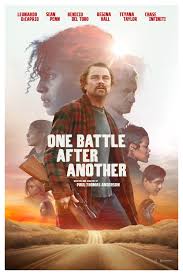
One Battle After Another (Paul Thomas Anderson)
That Paul Thomas Anderson won his long-overdue Oscar for what is by far his most commercially successful film is perhaps no real surprise given that body’s history, yet what is refreshing is that he achieved each of these feats without compromising his vision, his bold and cost-prohibitive aesthetic choices (including shooting on long-disused Vista-Vision cameras), or the directness with which this most recent movie addresses present-day issues such as the inhumane treatment of immigrants and the militarization of white supremacist policy. “We’ve been laid siege for hundreds of years,” Benicio Del Toro’s Sensei Sergio reminds/informs Leonardo DiCaprio’s Bob Ferguson halfway through the film, “don’t get selfish.”
DiCaprio’s Bob is a former bomb-maker for the French 75, a revolutionary collective fighting against a fascist military regime in an America of unspecified time period that looks and feels remarkably like our own. Bob escapes into hiding under an assumed alias with his daughter once her mother, Perfidia Beverly Hills (Teyana Taylor, in a performance that ends a third of the way through the movie and yet dominates the next two hours) turns state’s evidence and disappears. The film is so richly-layered and effective in large part because it emphasizes the human rather than direct or explicit political statement. This may rub some viewers the wrong way, particularly in such charged times as ours, and yet by focusing on his characters as nuanced individuals Anderson is able to explore these political realities in a way that is more genuine and lasting than a straight polemic. Perfidia, for example, is presented to us not as a weak-willed narc but as a black woman finally ground down by a system (personified by Sean Penn’s grotesque Stephen Lockjaw) that continuously robs her of her agency and personhood, and as a new mother suffering post-partum depression even as she is expected to project unflagging strength and resolve. That such a strong-willed woman must leave the country to live freely is one of many pointed statements the film makes about our current moment. It is equally pointed that Bob is able to check out from the fight for as long as he does while characters like Perfidia, Sergio, or Regina Hall’s Deanna have no choice but to live in it as their everyday reality.
Vineland, the Thomas Pynchon novel upon which the film is loosely based, deals with a group of 60s revolutionaries who have crashed into Reagan’s 80s and given up upon realizing that the battles they fought have been forfeit to conservative corporatized culture. By adapting it the way that he has, Anderson has replaced the burnout and fatigue of defeat with the oppressive and deadening sense that the fight never really ends. And yet, as the ending so hopefully reminds us, we still don’t have any choice but to keep fighting it.
Christopher Sailor
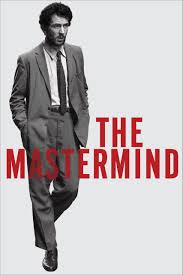
The Mastermind (Kelly Reichardt)
Kelly Reichardt’s The Mastermind may feel to many viewers like an act of thievery. Fans of the well-trodden heist genre typically come with a set of expectations and an appetite for certain genre staples: high speed thrills, gunfights, and (my personal favorite) thieves going up against laser fields. The Mastermind has no such trace of these elements.
The film, which stars Josh O’Connor as J.B. a down-and-out art thief in 1970s Massachusetts, performs a bait-and-switch, forgoing the typical beats of a heist flick in favor of offering both a character study of an anti-hero struggling to make ends meet and a meditation on the United States trying to pull itself back together during this calamitous era (The Nixon presidency and the fiasco of the Vietnam War loom in the film’s backdrop.) In The Mastermind heists go wrong, lofty dreams have a way of puttering out, and the protagonist would need to climb up a few levels to get back to rock bottom. Reichardt, a maestro in the slow cinema genre, also tongue-in-cheekly plays with viewer expectation when it comes to the film’s rhythm. In the place of rapid editing featured in typical heist films, we receive scenes such as a six-minute sequence with no dialogue of J.B. hiding his contraband in a barn. The deliberate pace gives Reichardt the expanded runway to explore themes such as the growing cynicism of the 1970s and an alienation that came from the breakdown of the myths of American exceptionalism and individualism.
Viewers’ mileage with The Mastermind will likely depend on if the stripping of the genre conventions results in a feeling of their time being robbed or as the film intends, through its slower tempo and subversions, a nice change of pace.
Kyle Brandys
Hedda (Nia DaCosta)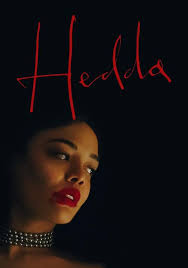
Nia DaCosta’s reimagining of Hedda Gabler, Henrik Ibsen’s 1891 play, saw no love from the 98th Academy Awards with zero Oscar nominations. Hedda also seemed to fly under the radar for mass audiences, with only a few critics singing its praises (most notably Richard Brody of The New Yorker). The lack of recognition is shocking, particularly given the precision of DaCosta’s vision.
DaCosta’s choices are not merely aesthetic; they fundamentally shift the way the character is read and provide a sophisticated critique of power and class. The story is set in a post-World War II English manor, which reframes the confinement of the titular character, Hedda Gabler. Hedda’s isolation is emphasized through the masterfully enigmatic choices of actress Tessa Thompson. Instead of the late nineteenth-century stuffy, bourgeois interiors of Ibsen’s play, DaCosta’s Hedda exists in a markedly transitory moment in history. The world of Thompson’s Hedda is shaped by war trauma, shifting class structures, and a sense of national rebuilding. This provides an additional layer of context in which Hedda finds herself, where social and cultural norms are being renegotiated and reasserted after disruption.
Cinematically, DaCosta has done her homework. Over the course of an evening, the camera follows Hedda as she dances between her husband, a former lover, a judge, and many other party guests, manipulating their fate. The constant camera movement, longer shot lengths, and social choreography are reminiscent of Jean Renoir’s 1939 film The Rules of the Game, in which upper-class French society is critiqued over the course of a debauched evening on the eve of WWII. DaCosta’s visual language is directly contradistinctive from the first major film production of Hedda Gabler in English, Hedda, released in 1975, directed by Trevor Nunn and starring Glenda Jackson, whose performance earned an Academy Award for Best Actress nomination. Nunn’s film adheres more closely to theatrical staging, in which the cinematic frame acts as a proscenium and characters move toward the camera to address the audience. Da Costa, however, mobilizes the camera, probing the social geography of the unfolding party and the house itself.
Ultimately, DeCosta’s Hedda is a thoughtful and deliberate reworking of Ibsen’s project. Through its historical repositioning, kinetic visual language, and powerful performances, the film reframes Hedda’s ambiguity as historically grounded in power, class, and identity. Earlier versions of Hedda Gabler contain Hedda within the confines of theatrical realism, yet DaCosta releases her into an unstable social ground constituted by historical forces. The central concern of the film is realized: who holds the power, and under what conditions?
Chloe Kwiatkowski
Dust Bunny (Bryan Fuller)
Action movies are hard. Like musicals, where the storyline is punctuated with music and dance to highlight the conflicts and desires of the characters, action movies emphasize the character’s struggles with shooting/kicking/swords/blowing stuff up. Dust Bunny is a surprising mix of action with childhood fantasy, comedy, and horror mechanics that stands out for the restraint it shows in blending and balancing them.
Aurora (Sophie Sloan), an 8-year-old foster child, has a monster under her bed – a giant floppy rabbit resembling a teenage emo haircut with long sharp teeth (you never see its eyes) that swims underneath the floorboards and bursts forth to consume its victims like a shark. Enter the Intriguing Neighbor (Mads Mikkelson) who lives across the hall. After watching him dispatch a gang of assassins, Aurora steals a collection plate from church and puts the cash in the Neighbor’s mailbox with a note requesting his services.
The film is not wall-to-wall action like a John Wick, although it wades in similar territory, but the action scenes have a touch of whimsy (my favorite is a hallway shootout where two FBI agents exchange fire with the Bad Guys while sliding back and forth across the floor) that remind us that we’re watching everything through the lens of a child’s imagination; a child that has frequently found herself surrounded by violence (her eaten foster parents were not the first, as the later part of the movie tantalizes us with) and has had to develop her own coping mechanisms. Aurora is not depicted as overly adult or capable, but writer/director Bryan Fuller and Sloan create a character that is coolly clear-headed about her decisions. Not once does she cry or break down amidst the death and killing in the film.
The film avoids easy missteps (e.g. taking the fantasy too literally, making Aurora annoying, overloading with quips, delving too much into the Neighbor’s backstory) and keeps the focus on the playful collision of styles along with the natural progression of Aurora and the Intriguing Neighbor’s endearing camaraderie; two stoic people finding warmth and comfort in each other, ready for their violent lives to be a thing of the past.
P.S. Sigourney Weaver is in this movie and she has gun shoes (her shoes are guns).
Andrew Salerno
28 Years Later (Danny Boyle)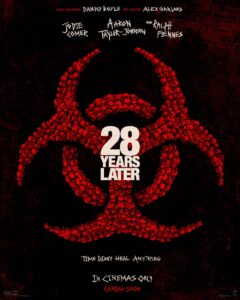
“Memento mori. Remember that you must die.”
Set decades after the original film hit cinemas in 2003, 28 Years Later follows Spike as he becomes exposed to the mainland for the first time and the infected horde that awaits. A film that begins on the day the disease hit rural Scotland and then transporting the audience to present day, Danny Boyle and Alex Garland establish the looming specter of death as a mindless mass that only knows rage and hunger.
Garland returns to a more meditative story with Years as the film presents death as a true inevitability. The first act of the movie begins a myth that life beyond our reach is to be a life ignored. After being infuriated by his father’s choices, Spike insists on seeking help for his ailing mother and thus journeys into the depths of the mainland for a doctor. The resulting tale told is a question about death. To fear it and run, or embrace and accept it? The end that awaits, while seemingly ugly, does not corrupt and instead transcends what came before it.
The film stuns with its cinematography by capturing the lush and vibrant English landscape and forest which invites the viewer to remember that nature and life are equal parts beauty and mercy to an impartial violence. The cinematography was shot using iPhones by returning collaborator Anthony Dod Mantle and truly captured something singular, an evolution from the DV look of the original 2003 film. Large, crescent shaped rigs made up to present photo montages creates new and dynamic approaches to action sequences and the filmmakers employ a red night vision stylization to illuminate our protagonist’s state of being.
Following a period of real tragedy, 28 Years Later invites the audience to remember that death is equal to life. There lies no discrepancy, it is finality and inevitability. Despite that reminder, the beauty we enjoy and the lives we touch along the way creates such a vitality that follows us beyond time.
“Memento amoris. Remember that you must love.”
Eric Crum
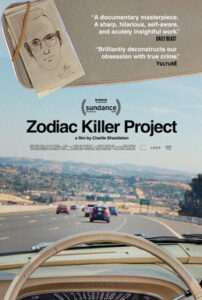
Zodiac Killer Project (Charlie Shackleton)
After the rights to the famous memoir, The Zodiac Killer Cover-Up, are revoked, filmmaker Charlie Shackleton continues to make the documentary adaptation as “Zodiac Killer Project”. This film, in some ways, satisfies the original project by quoting from the book and walking through detective Lyndon Lafferty’s experience in hunting the Zodiac Killer. However, the project also spends much time on the “what ifs”: the locations not filmed in, the interviews not conducted, the film techniques not used. This is where this documentary really shines. Shackleton walks us through a hypothetical film never realized. Yet this is the reality of so many documentary projects that either cannot execute their stories after pre-production research or cannot find their ending after production begins. To see a filmmaker defiantly unwilling to shelve yet another project is quietly thrilling.
Borne out of self-admitted failure, Zodiac Killer Project becomes a deconstruction of the true crime genre itself. Shackleton questions the genre’s clichés – from swinging interrogation lamps to isolated, silent towns to moody intro montages – while also recreating them as a playful subversion of the tropes. What we’re left with is a calm, soothing voice-over layered on lots of B-roll and cheeky reenactment. Slowly, the film peels away from its original subject of the Zodiac Killer and turns to critique of the oversaturated true crime genre, with specific blows aimed at certain recent Jeffrey Dahmer projects.
Zodiac Killer Project is an insightful essay film that supports a rising trend in meta true crime, along with this year’s haunting Predators. Shackleton is right that the true crime market is reaching an oversaturation point. This makes it the perfect moment to spin what may have otherwise been just another entry in an increasingly formulaic genre into an essential moment of self-reflection and assessment. Sure, revoked book rights feels like a loss in the moment, but the resulting documentary is surely a far richer project for it.
Yelizaveta Moss